
Thousands of open-source electronic kits circulate each year in classrooms and workshops, with no prior degree requirement. Arduino boards, originally designed to facilitate prototyping, are now integrated into educational programs at all levels, from middle school to continuing education.
Their low cost, abundant documentation, and wealth of online resources explain the rapid rise of these tools in teaching and training. Public and private initiatives are multiplying workshops, online or in-person, to meet the growing demand for skills in electronics and connected objects.
Why open-source boards like Arduino are shaking up electronics learning
Those who are starting out in electronics today no longer enter the field through the narrow door of dusty manuals. Open-source boards, primarily Arduino, are game changers for many learners and educators. Programming is no longer reserved for an elite: it becomes accessible, concrete, almost intuitive. The Arduino development interface breaks down barriers, and suddenly, creating your own interactive system is no longer a laboratory fantasy.
In classrooms, the observation is clear: hands-on experience precedes understanding. You assemble, connect, code, and then adjust. Theory comes later, driven by the desire to make a real object work. This shift, made possible by the abundance of online tutorials and community sharing, turns learning into a collective, open path where everyone can progress at their own pace.
Here are some key advantages that explain this paradigm shift:
- Test and adjust in real-time thanks to an accessible installation and setup, even for beginners
- Create projects where modules, sensors, and actuators communicate effortlessly
- Customize each project, whether you are discovering or already mastering electronics
Behind the blinking LED lies almost infinite possibilities: automate a greenhouse, monitor electrical consumption, set up an alert system. Gertduino illustrates this excitement and offers an inspiring alternative for those who want to go further. Platforms are multiplying, tools are diversifying, and every schematic, every line of shared code contributes to strengthening the autonomy and progress of each individual, without proprietary limitations slowing down the momentum.
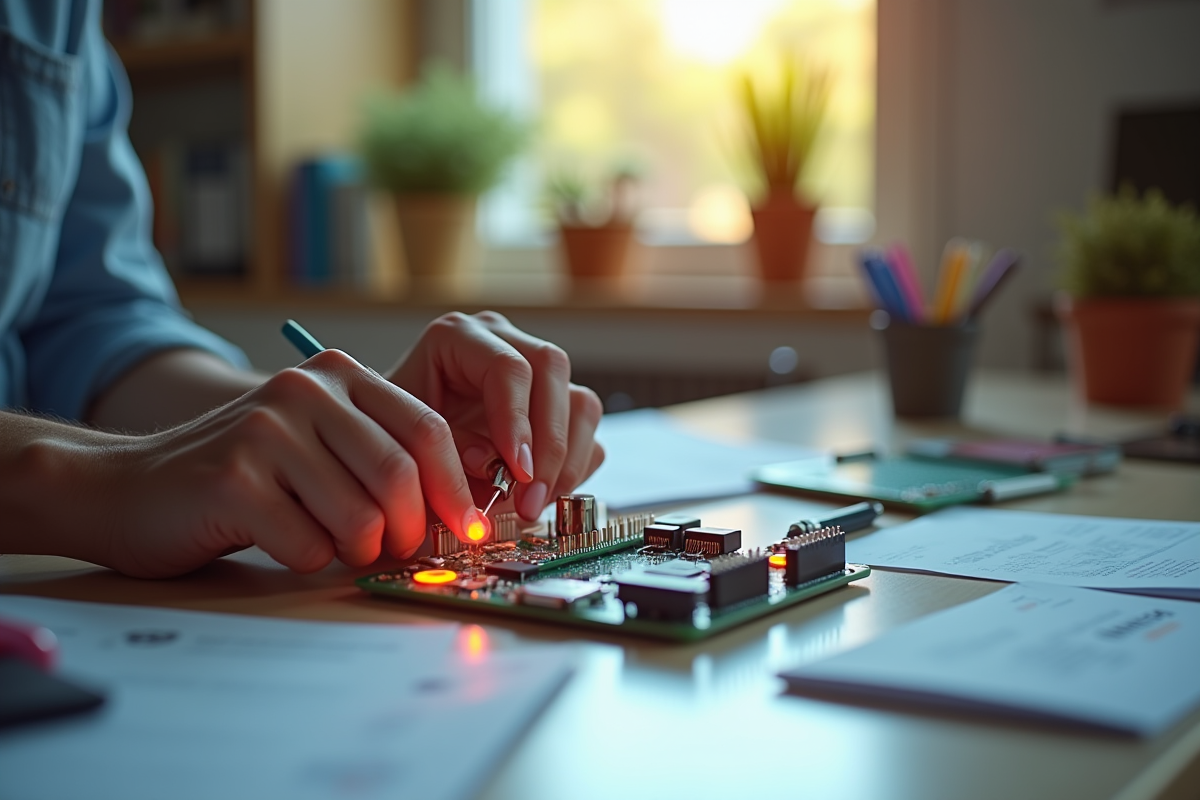
Training, projects, and resources: how to get started concretely with Arduino and IoT
Entering electronics today involves experimentation. Starting an Arduino training course, whether in a workshop or through an online platform, lays the groundwork: installing the environment, configuring the board, making initial setups on a breadboard, deciphering an electronic schematic, and understanding the role of each component. There is no shortage of resources: illustrated guides, step-by-step videos, collaborative workshops. This abundance facilitates the first steps and nurtures curiosity.
But it is through completing concrete projects that learning truly makes sense. Connecting a temperature sensor to a board, programming the transmission of measurements to the cloud, this is how varied skills develop, from electronics to programming, including project management. Connected objects offer a unique exploration ground for those who want to delve into real-time data analysis, automation, or dream of applications that blend electronics and artificial intelligence.
Here are some avenues to explore for effective progress:
- Get started with prototyping without soldering using breadboards
- Observe and analyze the data obtained to improve your programs
- Structure your approach, from the initial idea to the final realization
As soon as you rely on concrete examples, computer training reveals its full potential. Being guided by an instructor, exchanging ideas with enthusiasts on forums, accessing detailed schematics or shared codes: all these are levers for rapid progress. What makes an interactive project successful is the ability to mix technique, creativity, and mutual support. Open-source electronics proves this every day: it has never been easier to turn an idea into a prototype and to learn by building, step by step, with enthusiasm and inventiveness.