
Manage a virtual forest, see a population of predators collapse because too many prey have been removed, then understand why: ecological management games transform complex mechanisms into concrete decisions. Rather than piling up definitions about biodiversity or the water cycle, these games place the player face-to-face with the direct consequences of their choices on an ecosystem.
Systems Thinking: What an Ecological Game Teaches Without Saying It
You may have noticed that a documentary about deforestation moves you, but you forget the figures by the next day? An ecological management game works differently. It forces you to connect variables: soil quality depends on vegetation cover, which depends on available water, which in turn depends on forest cover.
This mechanism has a name in pedagogy: systems thinking. Recent research confirms that ecological games are increasingly designed as tools for systems thinking, rather than as mere awareness-raising supports for good practices. The idea is not to tell the player “sort your waste,” but to show them what happens when a link in the chain disappears.
Recent simulations go beyond the traditional food chain. Some digital games simultaneously vary soil, water, shade, nutrients, habitats, and seasons, while introducing drought, storms, or invasive species. The player no longer manages a simple prey-predator balance; they steer the resilience of an entire environment. To explore this type of approach, ecosysgame.fr offers an experience focused on the concrete management of interactions between species and resources.
Limits of Ecological Simulations: What a Game Does Not Replicate
Every simulation remains a simplified representation. This point deserves to be clearly stated, as it conditions what the player can actually learn.
An ecological management game chooses its rules. It decides which variables to include (temperature, rainfall, pollination) and which to ignore. Scientific literature emphasizes that the outcome always depends on the rules chosen by the designers. A real ecosystem contains thousands of simultaneous interactions that no game can fully model.
Let’s take a simple example. In many games, planting trees improves the situation. In reality, planting the wrong species in the wrong place can dry up an aquifer or eliminate a meadow rich in biodiversity. The game teaches the principle (trees store carbon), but not always the nuance (not all reforestation efforts are equal).
How to Get the Most Out of an Imperfect Simulation
The key is not to reject the game because it simplifies, but to know what it simplifies. Here are some useful reflexes:
- Identify the variables absent from the model. If the game does not simulate soil pollution, the player needs to know this to avoid believing that this factor does not exist.
- Compare the game’s results with real data. A debriefing after the game, even informal, doubles the educational value of the session.
- Vary the games. A game focused on the food chain complements another that models the water cycle or waste management well.
Co-design and Narratives: How Ecological Games Avoid Eco-Anxiety
A common pitfall of environmental awareness tools is to produce a catastrophic discourse. The player learns that everything is going wrong, feels powerless, and disengages.
A recent trend in the design of ecological games involves scientists, artists, and sometimes students from the creation phase. This co-design allows pessimistic narratives and constructive approaches to coexist. The player faces crises (drought, invasive species, pollution) but also has effective levers for action.
The Paris Climate Academy, after several years of experimentation with playful workshops, has formalized evaluation criteria that go beyond mere interest in the game. Among them: the scientific robustness of the content, suitability for the target audience, clarity of the process, inclusivity of the materials, and the diversity of solutions offered to the player.

What Distinguishes a Good Ecological Game from a Guilt-Inducing Tool
A good ecological management game does not simply punish bad decisions. It shows why a decision produces a certain effect and offers alternatives. The player understands the link between their actions and the state of the ecosystem without receiving a moral lesson.
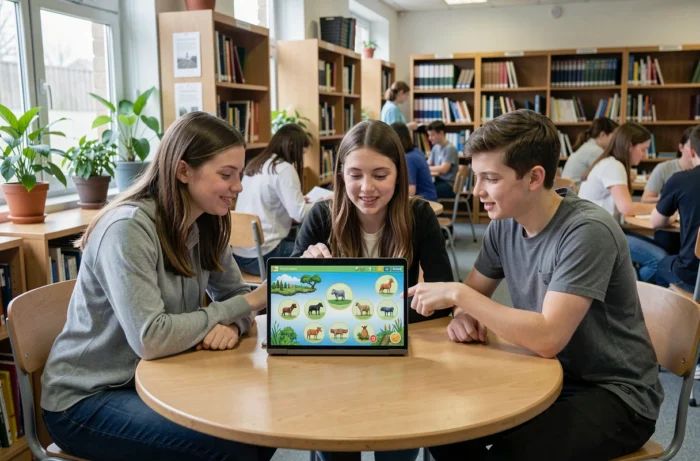
This mechanism is particularly useful in a school context, from primary school to high school. Education for sustainable development benefits from relying on tools where students experiment rather than listen. The game allows testing hypotheses without real consequences, freeing intellectual risk-taking.
Criteria for Choosing an Ecological Management Game Suitable for One’s Level
The choice of a game depends on the educational objective and the audience. A workshop in a middle school class has different needs than an evening among adults passionate about nature.
- The complexity of the simulated model: a game with three or four variables (water, vegetation, fauna, climate) is suitable for a beginner audience. Beyond that, the player must already master the basics of ecology.
- The duration of a game: short formats work better in school settings, while long simulations allow for observing effects over several virtual “seasons.”
- The presence of an integrated debriefing: some games offer an explanatory feedback at the end of each session, which anchors learning without requiring a specialized facilitator.
- The medium (board, digital, video): digital games allow for finer simulations with more variables, but a board game fosters direct exchange between players.
Ecological management through gaming does not replace a biology class or a field trip. It occupies a different space: one where mistakes become a learning tool and where the consequences of an imbalance can be seen in minutes rather than decades. Choosing a game whose model is transparent about its simplifications remains the best way to gain a lasting understanding of ecosystems.