
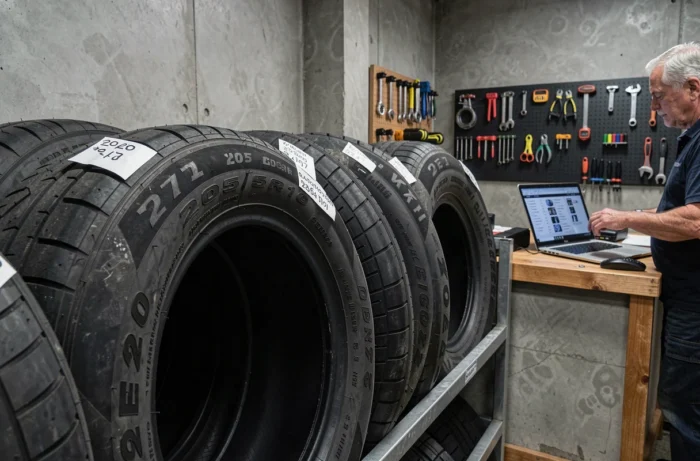
We are in front of the tire sidewall, crouched in the parking lot, and we read “205/55 R16 91V”. The sequence of numbers and letters looks like a foreign postal code. Each segment, however, describes a specific physical characteristic of the tire, and a reading error can lead to a purchase that is incompatible with the car, or even dangerous on wet roads.
What the tire sidewall indicates about its geometry
Let’s take the sequence in order. The first number (205, for example) corresponds to the width of the tire in millimeters, measured from one sidewall to the other once inflated and mounted on the intended rim. The larger this number, the wider the tread, which changes the contact area with the ground.
The number after the slash (55 in our example) expresses the ratio between the sidewall height and the width. This is referred to as “series” or aspect ratio. A 55 means that the sidewall height is 55% of the width. A tire with a 40 series will have a significantly lower sidewall, resulting in a stiffer handling in turns but less comfort over bumps.
The letter R indicates a radial structure, the almost universal standard for passenger cars. The number that follows (16) is the inner diameter of the tire expressed in inches, in other words, the diameter of the compatible rim. Mounting a 16-inch tire on a 15-inch rim is physically impossible.
To understand car tire dimensions beyond geometry, you also need to read the last two elements: the load index and the speed rating, which are as crucial for safety as the dimensions themselves.

Load index and speed rating: two markings that change everything
The number that follows the diameter (91 in “205/55 R16 91V”) represents the load index. This is not a weight in kilograms that can be read directly: it is a code that refers to a correspondence table. An index of 91 supports a maximum load per tire, and going below the index recommended by the manufacturer jeopardizes road handling as soon as the vehicle is loaded (full trunk, rear passengers, trailer).
The final letter (V, H, T, W, Y) corresponds to the speed rating, which is the maximum speed the tire can sustain continuously without risk of structural degradation. A tire rated H does not tolerate the same thermal stress as a tire rated V or W.
Why a tire of the same size may not be suitable
It is common to find two tires displaying the same sequence 205/55 R16 but with different load or speed indices. The common trap is to choose the cheaper one without checking these indices. A tire of the same size but with a lower index is not a valid equivalent.
The reference document remains the registration certificate (field S1) or the label affixed to the driver’s side door pillar. These sources indicate the approved dimensions for the vehicle, sometimes with several alternative sizes authorized by the manufacturer.
Alternative sizes and equivalences: what is allowed
Most vehicles accept two or three different tire sizes. Changing from a 195/65 R15 to a 205/55 R16, for example, modifies the width, sidewall height, and rim diameter, but can maintain an almost identical overall outer diameter. It is this total diameter that matters for the accuracy of the speedometer and the proper functioning of electronic aids (ABS, ESP).
- Check the authorized sizes in the manufacturer’s manual or on the door label before making a purchase.
- Compare the total outer diameter between the old and new size to limit the difference to a few millimeters.
- Maintain a load index at least equal to the original and a speed rating that is the same or higher.
- Mount tires of the same size and brand on the same axle, or risk a defect being reported during the technical inspection.
The technical inspection checks the consistency of the dimensions mounted on each axle. Mismatched tires between left and right constitute a reason for a re-inspection.
Tire size and winter obligation: an unknown trap
The Montagne law requires, in the affected areas, to have tires marked with 3PMSF or to have suitable chains. The point that many drivers are unaware of: the chains and socks must match the exact size of the mounted tire. Changing tire size without updating winter equipment can render them unusable on the day they are needed.
The technical inspection and the winter obligation do not cover the same criteria. The former checks the condition of the tire and the dimensional consistency by axle. The latter requires a specific marking (3PMSF) or an appropriate removable device. A setup can therefore pass the technical inspection without meeting the winter obligation in an affected department.
When the alternative size changes the game in winter
Some drivers mount a narrower size in winter to improve grip on snow (a 195/65 R15 instead of a 205/55 R16, for example). This practice is accepted as long as the size is among those approved by the manufacturer. The advantage of a narrower tire in winter lies in the pressure on the ground concentrated on a thinner strip, which improves penetration into the snow layer.
The tolerance for the outer diameter difference varies depending on the vehicle’s onboard systems. On a recent model equipped with integrated pressure sensors (TPMS), an unplanned size change can trigger false alerts on the dashboard.
Before ordering, it saves time to note the complete sequence inscribed on the sidewall, compare it with the authorized dimensions from the registration certificate, and then check that the load and speed indices cover the actual needs of the vehicle. Reading the sidewall takes thirty seconds, correcting a poor choice takes much longer.