The French automotive market offers dozens of vehicles labeled as “family-friendly,” but most fail on one specific point: fitting three car seats side by side on the rear bench. The width of the central seat, the frequent absence of Isofix anchorage in the middle seat, and the stricter requirements of the R129/i-Size standard significantly reduce the number of models that are truly compatible.
i-Size Standard and the End of R44: What Changes for Seat Compatibility
The manufacture of R44/04 approved seats ceased in September 2023, with retail sales ending in September 2024. Existing models remain usable, but families renewing their equipment are gradually transitioning to the R129/i-Size standard.
This transition alters the combinations that can physically fit on a bench. The R129 standard classifies seats according to the child’s size, mandates rear-facing until at least 15 months, and adds side-impact protection requirements. An i-Size seat can therefore be wider or more enveloping than an older R44 model, making certain configurations impossible even in vehicles advertised as having “three real seats.”
For a family buying a used vehicle, the check goes beyond the manufacturer’s specifications. It is essential to test compatibility with the seats that will actually be used, not just with those from the current catalog. Choosing a MPV or SUV with 3 real rear seats requires comparing the exact dimensions of the car seats to the vehicle’s interior measurements.
Bench Width and Isofix: The Technical Criteria That Differentiate Models
The marketing argument of “three rear seats” often masks a less flattering technical reality. Two criteria allow for a quick decision.
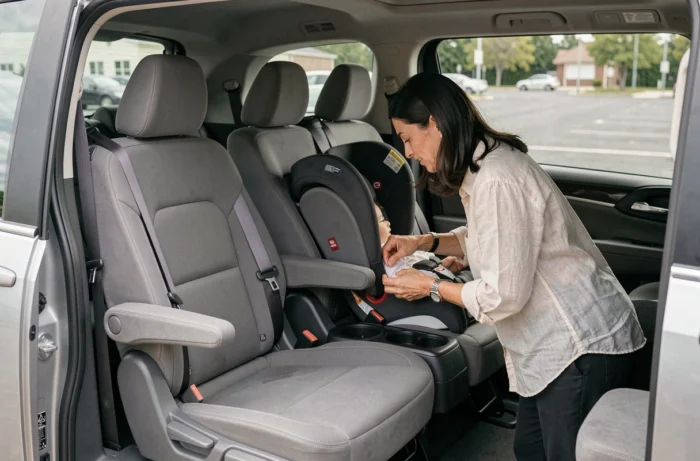
The first is the usable width of each seat. In a leisure vehicle like the Citroën Berlingo, each individual seat offers about 48 cm in width, providing the necessary margin for three infant carriers or boosters. In most sedans and compact SUVs, the central seat drops below 40 cm: a booster fits there, but a harnessed car seat rarely does.
The second criterion is the actual number of Isofix anchor points. Most five-seat vehicles only provide two Isofix points, on the side seats. The central seat then only accommodates a seat secured by a seatbelt. In a seven-seat vehicle, the third row presents a similar issue: Isofix is rare there, and the vehicle manual remains the only reliable source to know which seats accept which restraint devices.
- Check the manufacturer’s manual for the exact number of Isofix attachments per row, including the third row of seven-seaters.
- Measure the width between the side anchors and compare it to the combined footprint of the three planned car seats.
- Prefer models with sliding individual rear seats, which offer lateral adjustment impossible with a monoblock bench.
- Test the complete installation at the dealership before purchase, as catalog dimensions do not account for the thickness of upholstery or shell shapes.
Leisure Vehicles and MPVs vs. Seven-Seat SUVs: Different Compromises
Leisure vehicles (Berlingo, Rifter, Kangoo) dominate parent forum recommendations for a simple reason: their utility-derived architecture offers a greater interior volume than an equivalent-sized SUV. The flat floor, sliding doors, and headroom facilitate the installation of seats and the movement of children.
Seven-seat SUVs (Peugeot 5008, Skoda Kodiaq, Volkswagen Tiguan Allspace) appeal with their image and road behavior, but their third row remains a weak point for young children. The space is often designed for adults on short trips, not for harnessed car seats. And access through the foldable bench of the second row complicates each installation.
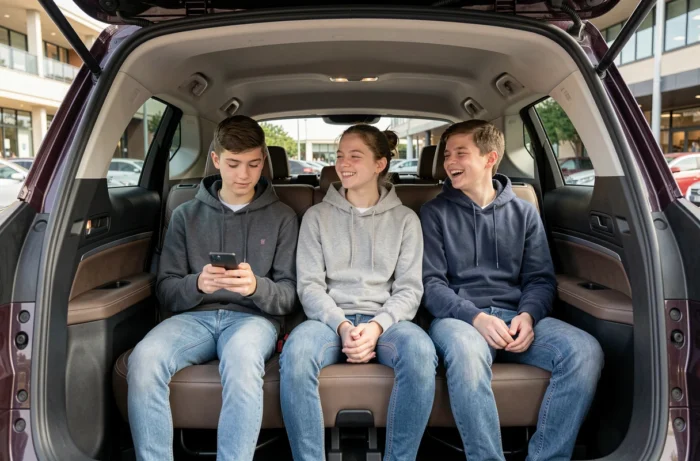
Classic MPVs (Volkswagen Touran, Renault Espace new generation) offer an interesting middle ground. Their second row with three independent sliding and reclining seats allows for adjusting the space between each car seat. The Touran remains one of the benchmarks for three Isofix points in the second row, a claim few SUVs can make.
Dacia Jogger and Peugeot 5008: Two Pricing Philosophies for Families
The Dacia Jogger illustrates a consciously economical approach. Its entry price is among the lowest in the seven-seat segment, making it the default choice for many families. The rear bench accommodates three car seats under acceptable conditions, although the trim level and sound insulation reflect its pricing position.
The new generation Peugeot 5008 sits at the opposite end of the budget spectrum. The modularity of its second row and the perceived quality of the interior justify a significantly higher price. However, the third row of the 5008 is better suited for children in boosters than for harnessed car seats, which brings the question back to the actual number of usable seats for toddlers.
Between these two extremes, the choice depends as much on budget as on the age of the children. A family with three children under four has much stricter anchorage and width constraints than a family whose oldest uses a simple booster. This parameter, rarely highlighted in comparisons, significantly alters the list of compatible vehicles.
The final criterion is neither the brand nor the segment, but the physical compatibility between three specific car seats and a specific cabin. Before any decision, the only reliable method remains testing at the dealership with the family’s car seats in hand, along with the vehicle manual.