In a 35 m² apartment with a neighbor below sensitive to the slightest impact, the choice of a treadmill is not made solely based on the technical specifications. The Sportstech F10 often comes up in searches for home training in small spaces, and it is precisely its compactness and focus on active walking that deserve attention.
Noise and vibrations in apartments: what the Sportstech F10 does not solve on its own
It is often thought that a silent motor is enough to ensure peace with neighbors. In reality, the vibrations transmitted through the floor matter more than the noise of the motor. A treadmill placed directly on floating parquet or thin tiles transmits impacts to the floor below, even at a slow pace.
The F10, designed for brisk walking and light jogging, generates fewer impacts than a model intended for sustained running. Feedback on this point varies depending on the type of flooring and the building’s insulation.
Before even comparing models, it is beneficial to check three practical elements:
- The type of flooring (concrete slab, wooden floor, floating parquet): a soft floor amplifies vibrations transmitted to neighbors.
- Compatibility with the condominium rules, which may restrict the use of fitness equipment to certain time slots.
- The addition of a cushioning mat under the device, which significantly reduces impact transmission even on a hard floor.
From a legal standpoint, the Public Health Code penalizes domestic noise that disturbs tranquility due to its duration, repetition, or intensity, regardless of the time. There is no “right to noise” before 10 PM. For a device used daily, the regularity of use may be enough to characterize a nuisance.
Maximum speed and running surface: who is the F10 really for
When searching for the Sportstech F10 treadmill, you find a device limited to a maximum speed of 10 km/h. This ceiling immediately excludes fast interval sessions or preparation for races like half-marathons.
The F10 is suitable for active walking and light jogging, not for intensive running training. For someone getting back into sports, who works standing and wants to move in the evening, or who complements another activity (cycling, weight training), this positioning makes sense.
The compact running surface reinforces this orientation. You can run comfortably at 8 or 9 km/h on a narrow belt, but beyond that, the stride shortens and comfort decreases. If your main goal remains daily brisk walking (between 5 and 7 km/h), the compact format of the F10 becomes a real advantage in a small living space.
Bluetooth connectivity and Kinomap app: practical interest in daily use
The F10 offers Bluetooth connectivity and compatibility with Kinomap, an app that simulates video routes. On paper, this is a classic selling point in this price range.
In practice, connectivity mainly changes the regularity of use. A treadmill installed in a living room or bedroom often ends up as a coat rack after a few weeks. Following a filmed route keeps engagement better than a screen displaying only speed.
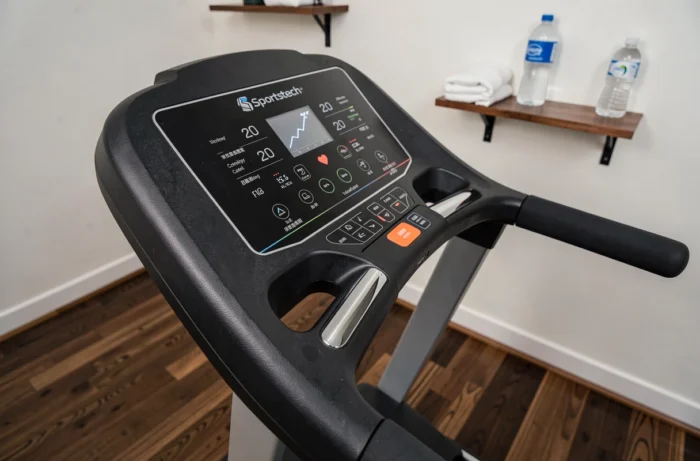
The integrated screen of the F10 remains basic. To fully enjoy Kinomap, you place a tablet or phone on the designated holder. Bluetooth transmits speed data to the app, which adjusts the route in real-time. This operation does not require a subscription to Sportstech, but Kinomap offers its own paid plans to access the entire catalog of routes.
Integrated training programs and motor limits
The F10 includes several pre-recorded programs that alternate speed phases. For someone who does not wish to manually set each session, these programs provide a sufficient framework to vary walking and jogging workouts.
The motor is sized for moderate use. An average-sized user who uses it four to five times a week for brisk walking does not push it beyond its capabilities. However, long sessions at maximum speed with a heavy user can accelerate wear.
A few guidelines to assess if the F10 suits your usage:
- Main goal of active walking or light jogging (no fast running or intense intervals).
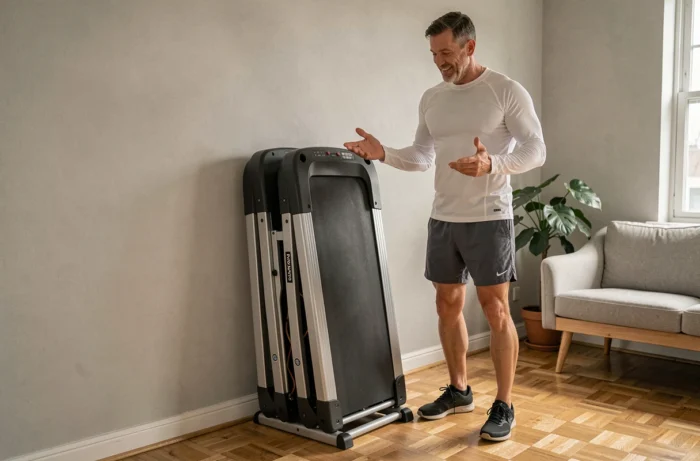
- Limited available space, with the possibility to fold or move the device after the session.
- Entry-level budget, with the understanding that durability directly depends on the intensity of use.
- Need for Bluetooth connectivity to pair with an app like Kinomap and diversify sessions.
Quick comparison: F10 against other Sportstech models
In the Sportstech range, the F10 is positioned as the most accessible model. The F31s and F37s go higher in speed and offer motorized incline, which opens the door to hill training and more varied muscle engagement.
| Criterion | F10 | F31s / F37s |
|---|---|---|
| Maximum speed | 10 km/h | Higher (sustained running possible) |
| Incline | Non-motorized | Motorized, several levels |
| Footprint | Compact, suitable for small spaces | Larger |
| Main use | Active walking, light jogging | Running, intervals, hill training |
| Price | Entry-level | Mid/high range |
Choosing the F10 means accepting a clear compromise: you sacrifice sports versatility for compactness and price. For daily brisk walking use in an apartment, this compromise holds. For someone planning to progress to running, a model with incline and higher speed will be more suitable in the medium term.
The right decision criterion is not the most impressive technical sheet, but the suitability between the device and the actual use you will make of it in six months.