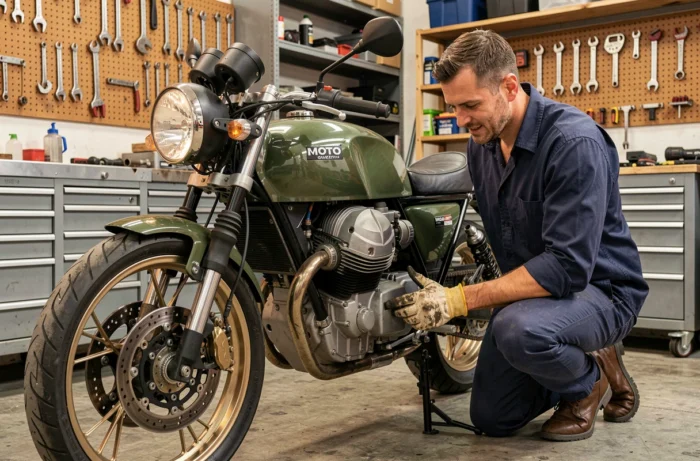
On the Moto Guzzi V85 TT, overheating is not a bug; it is a direct consequence of the architecture. The transverse twin-cylinder engine of this machine is air and oil cooled, without a liquid circuit. Any diagnostic approach that starts by looking for a radiator, thermostat, or water pump is going in the wrong direction. The thermal behavior of this motorcycle follows specific rules that must be understood before touching anything.
Air-oil cooling on the V85 TT: what it changes for thermal diagnosis
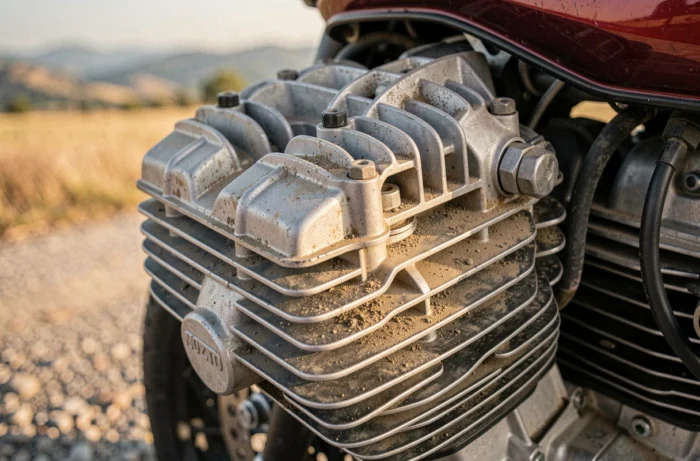
A liquid-cooled engine has a closed circuit with a pump, radiator, and thermostat that actively regulate the temperature. On the V85 TT, none of this exists. The dissipation of heat relies on two passive mechanisms: the airflow over the cylinders and fins, and the circulation of engine oil that absorbs some of the heat before passing through a low-capacity oil radiator.
This architecture means that engine temperature directly depends on speed. When riding at a steady pace on the road or highway, the airflow is more than sufficient. However, in traffic jams or during prolonged idling, the temperature mechanically rises because no fan takes over as effectively as in a liquid circuit.
We regularly observe that owners become alarmed when seeing the temperature gauge rise in the city, while this behavior is normal for this architecture. The real warning sign is a temperature that does not drop once riding resumes.
To delve deeper into the specifics of this model, we recommend resolving an issue on the Moto Guzzi V85 TT by always starting with qualifying the usage before suspecting a mechanical failure.
Engine oil and overheating of the Moto Guzzi V85 TT: the underestimated parameter
In an air-oil engine, oil is not only used for lubrication. It plays a major thermal role by transporting heat from the hot areas to the oil radiator. An insufficient level or degraded oil directly compromises this transfer function.
- A low oil level reduces the volume of fluid available to absorb heat, which accelerates the temperature rise during low airflow phases.
- Old oil loses its hot viscosity properties: the protective film thins, friction increases, and the engine produces more heat than it can dissipate.
- An oil grade unsuitable for the season or usage conditions (such as summer rides with loads on hilly terrain) significantly alters the thermal behavior.
Checking the oil level and quality is the first reflex before any other investigation. On the V85 TT, we recommend strictly adhering to the manufacturer’s recommendations for oil grade and change intervals, shortening them if the usage involves many urban trips or high temperatures.
Usage conditions: identifying risky scenarios on the road
Overheating on the V85 TT is almost never an isolated mechanical problem. It is the combination of several usage factors that pushes the engine beyond its comfortable thermal range.
Slow traffic and prolonged idling phases
This is the most common scenario. Without speed, there is no airflow over the cylinders. The oil radiator also loses efficiency. On an air-cooled motorcycle, remaining stationary with the engine running for several minutes is the worst thermal scenario.
The solution is simple: turn off the engine during prolonged stops. At traffic lights, if the wait exceeds a minute, it is better to shut off and restart than to let the twin run idle.
Load, terrain, and outside temperature
Riding two-up with luggage on mountain roads in the middle of summer combines three aggravating factors: the load increases engine effort, the terrain requires sustained low-speed revs, and the ambient temperature reduces the thermal differential necessary for air cooling.
In these conditions, we recommend taking regular breaks to allow the engine to cool down. Maintaining a slight throttle on descents rather than cutting off the injection also helps to keep oil circulation active.
Engine evolution 2024 and thermal behavior of the V85 TT
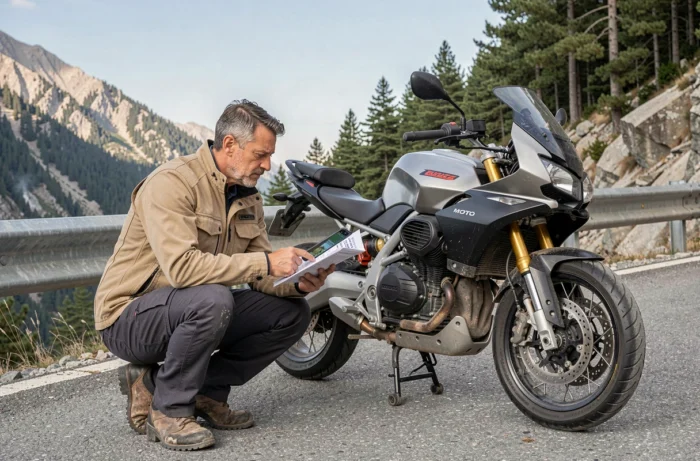
The 2024 version of the V85 TT introduces variable valve timing that modifies the engine behavior at different revs. This evolution has direct implications for thermal management: advice valid for models 2019-2023 does not automatically apply to the 2024 model year.
The engine mapping differs, the adapted rev ranges are no longer the same, and the throttle response changes. Before applying any adjustments or modifying your riding habits to manage temperature, check the year of your motorcycle and the version of the mapping installed.
On models prior to 2024, some owners report that a mapping update by the dealer improved thermal behavior in the city. This is a lead to explore before considering hardware modifications.
Warning signs and critical thresholds to monitor
Not all heating episodes are the same. On an air-oil engine, a temperature rise in traffic followed by a return to normal on open roads does not constitute overheating. This is the expected operation.
- A temperature that does not drop after several minutes of riding at normal speed indicates a real problem (oil level, blocked oil radiator, head gasket).
- A loss of power accompanied by a temperature rise indicates a potentially too-lean mixture or an injection problem that needs diagnosing.
- Unusual odors (burnt oil, plastic) combined with high temperature require an immediate stop and a thorough check.
The diagnosis always starts with usage, never with disassembly. Before suspecting a faulty gasket or sensor, reconstruct the exact conditions of the heating episode: duration at idle, outside temperature, load, terrain, oil condition. In the vast majority of cases on the V85 TT, the answer lies in adapting riding to the inherent limits of air cooling.