An umbrella always consists of the same elements: a shaft, a canopy, ribs, an opening mechanism, and a handle. The difference between a model costing a few euros and a durable model lies in the materials chosen for each of these parts and how they interact under stress. Understanding these components allows for a choice based on verifiable criteria rather than an attractive package.
Wind resistance: what commercial mentions do not specify
Many manufacturers display wind resistance expressed in kilometers per hour. These figures are rarely comparable from one brand to another. No ISO, European, or ASTM standard sets a wind resistance threshold for portable folding umbrellas. The only specifically documented method is the Chinese standard GB/T 31895-2015, which describes a testing protocol without establishing a universal performance class.
A manufacturer can therefore claim resistance to strong winds without specifying the laboratory, the method used, or the success criteria applied. To assess the actual sturdiness of an umbrella, it is better to examine the criteria for the best umbrella by focusing on behavior after inversion.
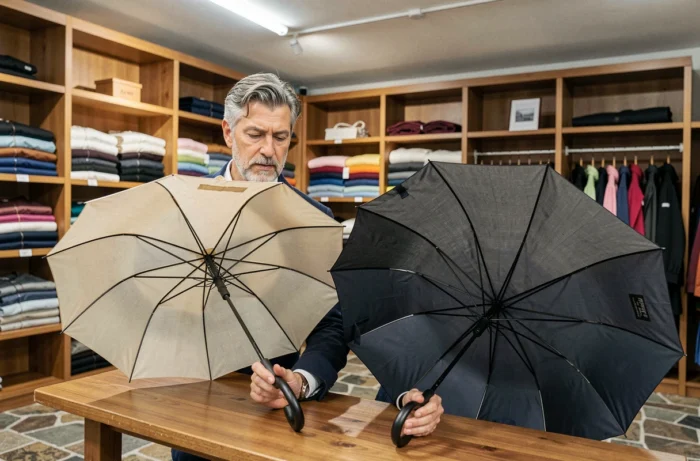
A good umbrella inverts without breaking, then returns to its shape. The ribs must remain aligned, the canopy should be able to be repositioned without tools, and the opening mechanism must function normally after the incident. This recovery criterion is far more reliable than a wind speed listed on the label.
Ribs and shaft materials: fiberglass vs. steel
The ribs determine the rigidity and flexibility of the structure. Two main families of materials stand out.
- Fiberglass ribs offer a flexibility that allows them to bend under wind pressure and then return to position. They resist mechanical fatigue better than steel in the long term.
- Steel ribs are stiffer and provide a taut canopy, but they deform permanently beyond a certain stress threshold.
- Some models combine both: a steel frame for central rigidity and fiberglass tips to absorb gusts. This hybrid setup often represents a good compromise.
The shaft follows the same logic. An aluminum shaft lightens the whole, while a steel shaft weighs down the umbrella but stabilizes the structure. Wooden shafts, reserved for high-end stick umbrellas, provide rigidity and aesthetics, at the cost of a higher weight.
Sun protection of the umbrella: color is not enough
Using an umbrella as a parasol is common, but UV protection cannot be deduced from color or the mere presence of a coating. The transmission of ultraviolet rays depends on the finished canopy as a whole: dyeing, printing, coating, and any perforated areas.
A black umbrella does not automatically offer better UV filtration than a light-colored model treated with an appropriate coating. For reliable sun protection, the measurement must be taken on the fabric after manufacturing, and ideally verified after aging. Manufacturers that provide a UPF index measured in a laboratory offer usable information. Others leave room for doubt.
Polyester, pongee, or Teflon canopy
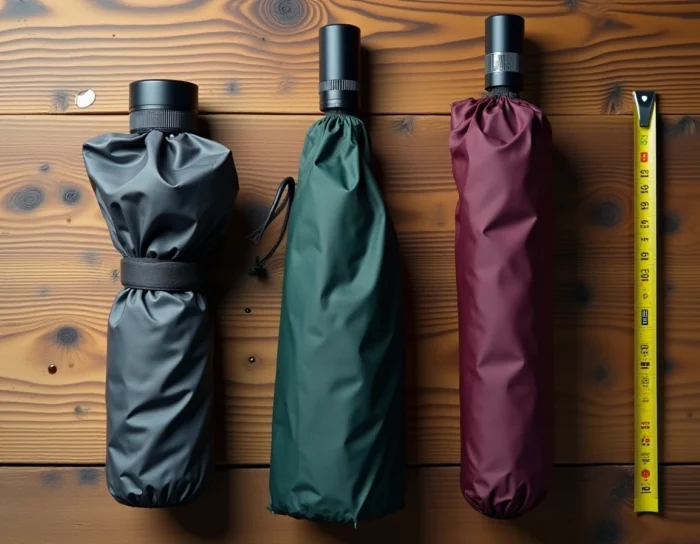
Standard polyester equips the majority of umbrellas on the market. It dries quickly and resists wear adequately. Pongee, a finer woven polyester, provides a silkier feel and a more compact fold, making it popular on travel folding models.
Water-repellent treatments (often based on fluoropolymers) improve water runoff on the surface. Water beads and slides off instead of soaking into the fabric, which reduces the weight of the wet umbrella and speeds up drying. This treatment wears off over time: regularly rubbing the canopy or washing it with harsh detergents accelerates its degradation.
Choosing between folding umbrella and stick umbrella
The format determines daily use more than any other criterion. A folding umbrella slips into a bag and is suitable for urban travel, public transport, and short trips. Its compactness comes at a cost: the telescopic mechanism multiplies the number of joints, thus increasing potential points of fragility.
The stick umbrella (or straight) offers a wider canopy span and a more robust structure thanks to a one-piece shaft or only two sections. It provides better protection during long walks in the rain, but it does not fit into a backpack.
Opening mechanism: manual or automatic
Manual opening limits the number of mechanical parts and reduces the risk of failure. Automatic opening (a push-button) adds a spring and a locking system that facilitate one-handed operation. Models termed “auto open/close” combine automatic opening and closing, convenient during a sudden downpour but heavier and slightly bulkier.
A simple mechanism lasts longer than a complex one. For intensive daily use, manual remains the most reliable choice. For occasional use where speed is a priority, automatic makes sense.
Handle and grip: an underestimated criterion
The handle determines comfort over time. A handle that is too thin tires the hand in a few minutes. Ergonomic handles made of soft rubber better absorb vibrations transmitted by the wind. Heavier wooden or horn handles stabilize the stick umbrella and age with character.
The shape is as important as the material. A curved handle allows the umbrella to be hung on an arm or a chair back. A straight handle offers a firmer grip to withstand gusts. The choice depends on the use: urban mobility or prolonged walking in the rain.
One last point deserves attention: the availability of spare parts. An umbrella whose ribs, spring, or canopy can be replaced separately lasts for years. Without spare parts, even the slightest breakage condemns the entire item, regardless of the price paid at purchase.