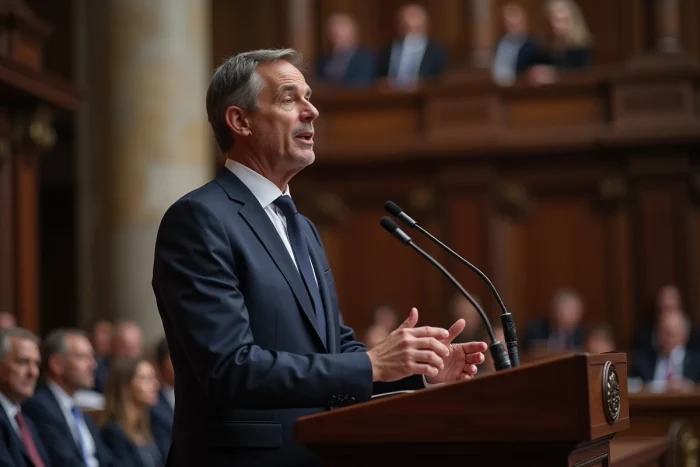
The French political landscape is undergoing a profound reconfiguration. Traditional markers of the left-right divide are fading in favor of new fault lines, driven by sociological, territorial, and institutional dynamics. Understanding political power in France requires analyzing the underlying trends that are reshaping the balance of power well beyond electoral deadlines.
Tripartition of the French political landscape: a lasting divide
Research from CEVIPOF and the Jean-Jaurès Foundation converges on one observation: French politics is now structured into three distinct sociological blocs. The radical right is rooted in the peripheries and small towns. The liberal and pro-European center recruits from large, educated metropolitan areas. The ecological and social left relies on popular urban centers and the public sector.
This tripartition is not a conjunctural accident. Electoral surveys conducted since the European and regional elections show that each bloc has an increasingly stable territorial and social anchorage. The transfer of votes between these three poles remains minor from one election to the next.
Following current events on Les Marches du Pouvoir allows for placing individual maneuvers within the structural framework that conditions them. The central issue is not who wins a televised debate, but which bloc is making progress in which territories.

Mistrust towards institutions: what the CEVIPOF barometer reveals
The CEVIPOF political trust barometer has documented for several waves a persistent mistrust of the French towards their institutions. Levels of trust in political parties, Parliament, and the executive remain low, with no significant rebound despite alternations and reshuffles.
This mistrust does not translate into disinterest. On the contrary, it fuels parallel forms of mobilization: sectoral social movements, legal actions against the state, increased participation in local consultations. The population is not turning away from politics; it is circumventing traditional institutional channels.
Trust and autonomy: two contradictory demands
The CEVIPOF data highlight a tension. The French simultaneously express a need for public protection (on employment, health, security) and a demand for autonomy from the state in their daily lives. This contradiction shapes the political debate far more than partisan labels.
None of the three blocs manages to resolve this tension. The radical right promises protection but rejects autonomy on societal issues. The liberal center values autonomy but struggles to respond to the demand for social protection. The ecological left oscillates between the two registers depending on the topics.
Judicialization of political power in France: an unprecedented power dynamic
Several recent decisions from the Constitutional Council, the Council of State, and the European Court of Human Rights have constrained the executive on major issues: immigration, security, management of protests. This phenomenon fuels a recurring discourse on the growing judicialization of political life.
Studies from the Montaigne Institute indicate a multiplication of conflicts between the executive and judicial powers. Political leaders increasingly invoke an obstruction to their actions by the courts. In return, judges and legal experts defend the role of constitutional counter-power against texts deemed non-compliant with fundamental rights.
An electoral battleground
The question of the “power of judges” has become a campaign argument. Some candidates for the 2027 presidential election are making it a programmatic axis, promising to limit judicial oversight over laws passed by Parliament. Others, conversely, present judicial independence as a bulwark against authoritarianism.
The available data do not allow for concluding that judicial activity has objectively increased in volume. However, the media visibility of court decisions on political issues has significantly progressed, which fuels the perception of a permanent conflict.

Presidential election 2027: trends to watch in the polls
Opinion barometers published in spring 2026 place Emmanuel Macron’s popularity rating at a persistently low level, with unfavorable opinions far exceeding favorable ones. This context of significant economic concern weighs on the entire executive.
Sébastien Lecornu’s rating is being closely monitored as an indicator of the presidential camp’s ability to maintain an electoral base for 2027. Movements of a few points in these barometers, month after month, outline trajectories that party leaders are closely scrutinizing.
Three questions that structure the pre-electoral sequence
- The ability of the National Rally to consolidate its electorate beyond its suburban strongholds, as CEVIPOF analyses point to a glass ceiling in large metropolitan areas.
- The positioning of center candidates on the issue of purchasing power, the primary concern of the French in opinion polls.
- The gap between voting intentions and actual mobilization, in a context where abstention remains the first party in France in every mid-term election.
Field reports diverge on the ability of parties to mobilize new voters. Registrations on electoral rolls are increasing in certain age groups, but the translation into actual participation remains uncertain.
The ongoing sociological, institutional, and territorial transformations will weigh on the 2027 presidential election as much as the candidacies themselves. The differential abstention between the three blocs, measured election after election, will be a determining factor.