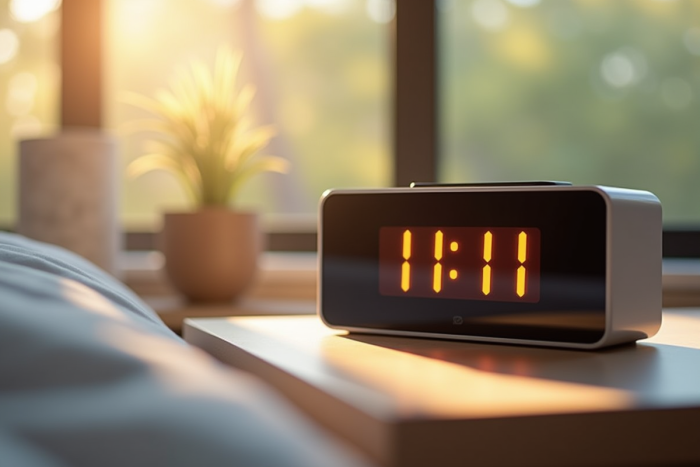
At 11:11, the likelihood of noticing the time on a digital watch increases disproportionately compared to other combinations. Social media platforms record a significant rise in posts around these double hours, often accompanied by personal testimonies or lively debates. Despite the lack of scientific foundation, millions of monthly searches on this phenomenon persist worldwide. Some psychological organizations report a surge in consultations related to the interpretation of these temporal coincidences.
Mirror Hours and Synchronicities: Where Does This Fascination for Everyday Signs Come From?
It’s hard to ignore the phenomenon: mirror hours have slipped into our habits and discussions, surpassing the mere curiosity of a repeating number. In uncertainty, the need to cling to a hidden meaning or an explanation we believe we can guess is felt, even on the screen of a watch. The aligning numbers intrigue, whether they are classics like “ 11:22 ” or other rarer combinations.
Behind this collective reflex lies a story of psychology. Carl Jung, a pioneer of the concept of synchronicity, demonstrated how the human mind tends to connect seemingly unrelated facts. The phenomenon is also fueled by another mechanism: confirmation bias. Encountering the same hour over and over, then associating it with a significant thought or a period of doubt, is enough to plant the idea that a message is hidden there, between two numbers.
Social media plays a significant role: everyone shares their own interpretation, proposes lists of meanings, or exchanges thoughts on messages from the universe. This amplification effect has firmly established mirror hours in our contemporary culture. For some, it’s just a wink from chance. Others see it as an invitation for inner questioning or to probe their beliefs. Between double hours, triple hours, and games of inverted mirrors, the back-and-forth between skepticism and belief continues.
This constant back-and-forth sheds light on our relationship with signs: always on the lookout, we track a bit of wonder in the ordinary, even if it sometimes means forcing meaning or inventing our own markers. Ultimately, this search for alignment reflects an almost universal desire: to find a logic, even fleeting, in the succession of days.

Deciphering Spiritual Messages: How to Interpret the Presence of Mirror Hours in Your Life
Regularly encountering a mirror hour raises a dilemma: should it be seen as a message intended for you, mere chance, or an opportunity to advance on your own path? For numerology, each number has its own vibration. The famous “11:11” would thus symbolize, for some, a time of change or transformation.
Those who believe in the spiritual significance of these synchronicities have their own guidelines: listen to your intuition and observe what you feel when the hour appears. Many make it a habit to keep a mirror hour journal, noting each coincidence, the mood of the day, and the small events associated with it. This ritual helps to take a step back, to view things from a new angle, and to question the origin of these messages—intuition, belief, or simple psychological mechanics.
Some guidelines help maintain a proper distance from the urge to interpret everything:
- Accept that not everything necessarily has a precise meaning, and that the meaning can evolve according to personal circumstances.
- Use tools like divination or numerology to open up reflection, while preserving a degree of discernment and critical thinking.
- Ensure to maintain a balance between the quest for meaning and independent thought, without succumbing to the temptation to explain everything.
Mirror hours play a particular role: for some, they are moments of questioning; for others, a light-hearted wink, sometimes even a simple reminder to stay attentive to the little details. Interpretation evolves with time and experience, revealing a whole aspect of our relationship with chance, symbols, and those fleeting signs to which we sometimes like to attribute hidden power.
So, the next time you come across 11:11, you might just feel a doubt brush against you: should you smile, remain rational, or simply let that suspended time slip away between chance and intuition?